“Since I have to spend money on treatment anyway, why not choose a hospital where I feel comfortable?”
This year, 77-year-old Ms. Mai (pseudonym) has just completed a cervical disc ozone ablation procedure at Guangzhou Fuda Cancer Hospital. Energetic and in good spirits, she is in fact a seasoned “veteran” who has been battling cancer for 18 years.
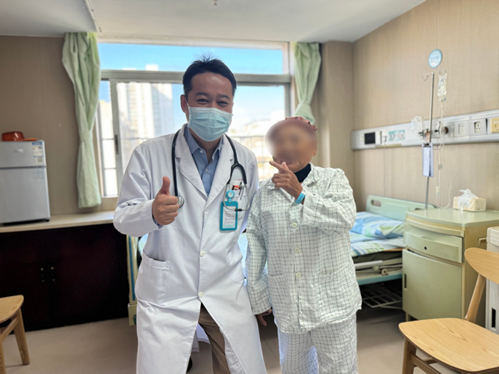
△ Director Liu Shupeng of Medical Department V with Ms. Mai
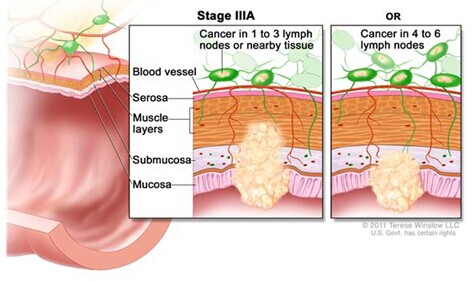
In 2007, Ms. Mai was diagnosed with ascending colon cancer after experiencing abdominal pain. She underwent surgery, chemotherapy, immunotherapy, and other treatments at a local hospital. Unfortunately, the cancer later recurred, accompanied by multiple lymph node metastases.
Large hospitals are often overcrowded, with long waiting times and limited beds. In 2022, upon recommendation, Ms. Mai came to Medical Department V at Fuda Hospital. At that time, examinations revealed a nodular, cauliflower-like mass measuring approximately 2 cm × 2.5 cm with an uneven surface in her intestine. Doctors promptly performed a surgical resection. Although she was readmitted one month later due to intestinal obstruction, her colon cancer has since remained stable, with no further recurrence or metastasis.
While the cancer was under control, age-related conditions gradually emerged. In recent years, Ms. Mai suffered from severe pain in her neck, lower back, and legs, which significantly affected her daily life. She previously received acupuncture and massage therapy at Fuda’s Traditional Chinese Medicine Department, with relief lasting for several years. However, this year the pain became difficult to manage.
Further examinations showed prominent disc degeneration in both her cervical and lumbar spine, with particularly severe neck pain. The Medical Department V team recommended the hospital’s newly introduced ozone ablation therapy. Without hesitation, Ms. Mai agreed. Having been treated at Fuda since 2022, she has developed deep trust in the doctors and nurses.
“If they think it’s suitable for me, I trust them,” she said.
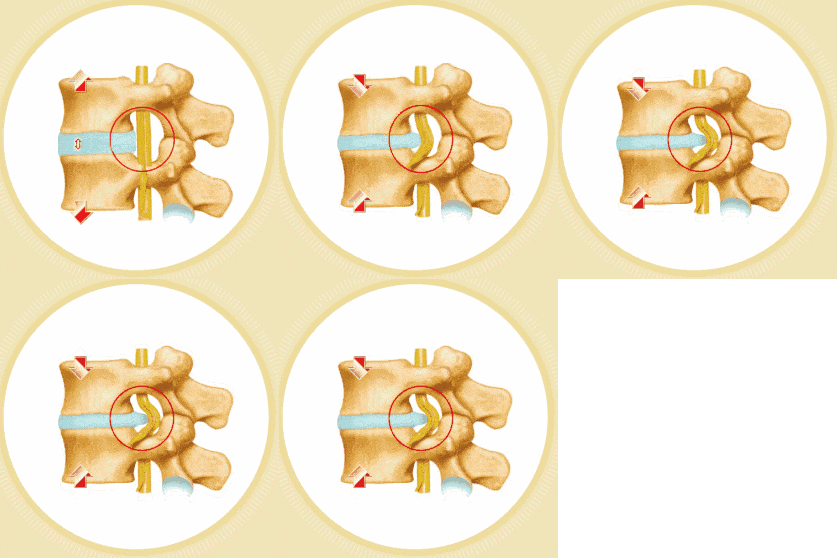
△ Image source: Internet
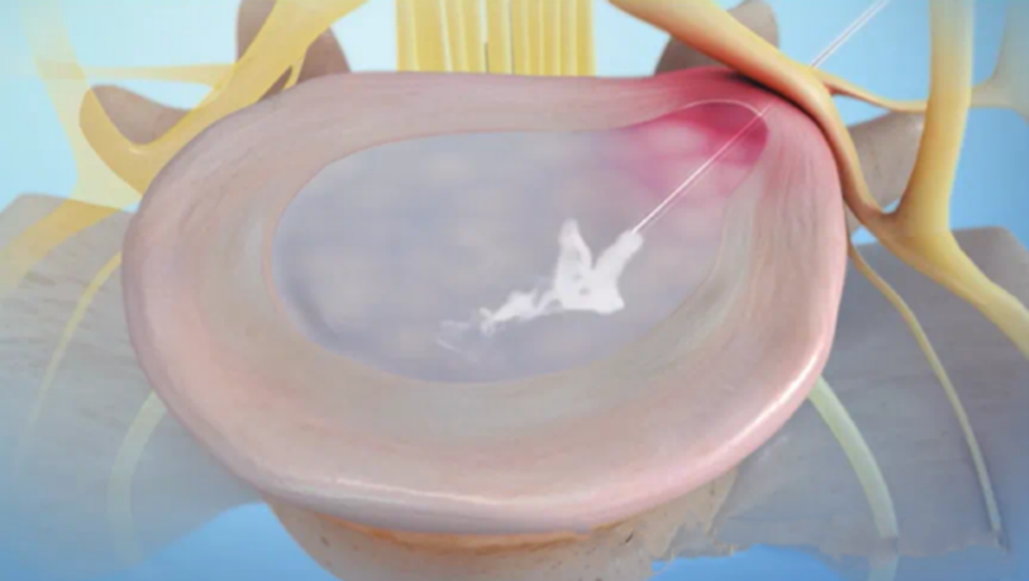
Ozone ablation is a rapidly developing minimally invasive interventional technique in recent years. Under precise image guidance (such as DSA or CT), medical ozone is injected directly into the affected intervertebral disc. Through its combined oxidative, anti-inflammatory, and ablation effects, ozone rapidly relieves nerve compression and promotes tissue repair. With advantages including minimal invasiveness, high efficiency, safety, and low trauma, it is often referred to as a “green therapy.”
With a single injection achieving dual effects, ozone specifically oxidizes the nucleus pulposus, causing contraction and solidification of the liquefied disc material, eliminating chemical and immunogenic irritation. At the same time, it exerts strong anti-inflammatory and analgesic effects. When injected around the nerve root, radicular pain can be relieved almost immediately. Over time, the nucleus pulposus gradually shrinks and solidifies, preventing further protrusion.
△ Image source: Internet
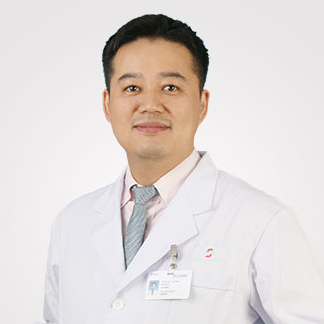
During the procedure, under DSA fluoroscopic guidance, Vice President Professor Shang Jianbiao precisely positioned the target area and used a 21G fine needle to accurately access the C5/6 and C6/7 intervertebral spaces, injecting ozone at an appropriate concentration. The puncture site required only a simple adhesive dressing. Although Ms. Mai needed to lie flat for one day after the procedure and avoid moving her neck—which she found somewhat uncomfortable—she soon felt significant relief. The neck pain subsided, and she felt much lighter and more relaxed overall.
Indications for Ozone Ablation Therapy
Obvious clinical symptoms, such as persistent low back and leg pain or intermittent claudication;
Positive signs of spinal nerve compression or sensory abnormalities, such as a positive straight-leg-raising test;
Imaging confirmation of contained or simple disc herniation, with findings consistent with clinical symptoms and signs;
Poor response after more than 8 weeks of conservative treatment;
Unsatisfactory results from surgical treatment or other minimally invasive disc therapies;
Chronic low back pain unresponsive to long-term conservative treatment, without obvious nerve compression symptoms, but with imaging-confirmed disc pathology (e.g., disc bulging) at the corresponding level, and exclusion of other causes.
“Since treatment costs money anyway, why not choose a hospital where I feel comfortable and at ease?”
Over the years and through multiple hospital stays, Ms. Mai has not only received effective treatment at Fuda but also experienced genuine care and reliability. This is why she has become a “returning patient.”
Ms. Mai’s story is far from unique at Fuda. Many patients who once overcame major illnesses here choose to return when facing other health issues, coming back to this “familiar place” as trusted returning patients. This continuity of trust forms a positive cycle in the doctor-patient relationship.
From cancer treatment to geriatric pain management and long-term rehabilitation, departments across the hospital work closely together to accompany patients through every stage of their health journey. We understand that every treatment represents a unique life entrusted to us. A hospital should not only be a place of medical technology to relieve suffering, but also a reliable partner safeguarding health throughout the entire life cycle. Interdepartmental collaboration is not merely technical—it is holistic, human-centered care.
Whether you are visiting for the first time or returning as a familiar friend, what remains unchanged is our commitment to care grounded in professionalism and guided by sincerity. With medical excellence and compassion, we strive to accompany every family safely through the long river of life.