“I must bow to the hospital president and the department director—you saved our whole family.”
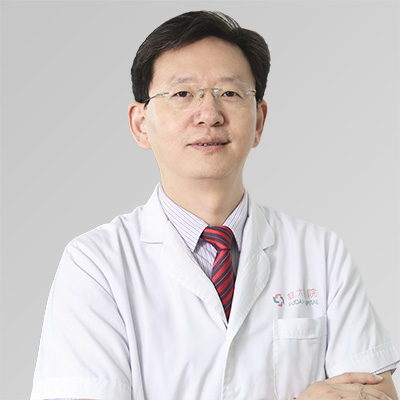
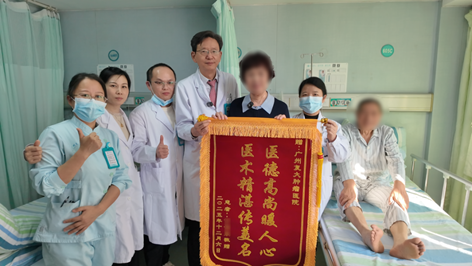
As she presented a banner of gratitude to President Niu Lizhi and Director Li Hongmei, Uncle Ding’s wife bowed deeply. Her eyes brimmed with tears, her voice trembling as she repeated again and again, “Thank you—truly, thank you…”
The story goes back to July 2025. Uncle Ding, in his seventies and from Henan Province, initially had only a cough with phlegm. Assuming it was chronic pharyngitis or a minor cold, he received injections and medication at a community clinic. But the symptoms lingered. A chest CT at a local hospital brought grave news from the doctor: “There’s a problem in the lungs.”
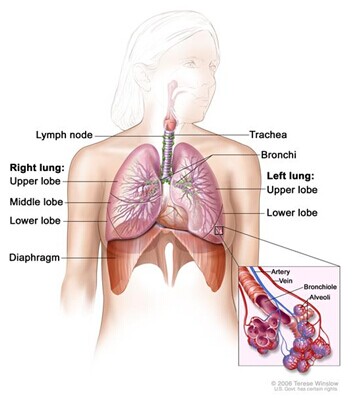
After visits to multiple hospitals, the diagnosis became clear: multiple nodules in both lungs. In the left upper lobe, there was a 2.1 × 1.7 cm solid nodule with irregular margins, suspicious for malignancy. The right lung harbored several ground-glass nodules, considered early-stage lung cancer; the largest measured 2.6 × 2.1 × 2.4 cm, located subpleurally in the posterior segment of the right upper lobe.
With a thick stack of reports, the family traveled to Beijing. Days of queuing and waiting led to a sobering assessment from specialists: heart disease, spinal problems, two prior stent procedures, advanced age, and lesions in both lungs. Surgery would be extremely risky—if one side were resected, the other might not be operable later, and postoperative recovery was uncertain. Each sentence felt like a hammer blow. Hope seemed to fade.
“Why not try Guangzhou Fuda Cancer Hospital?” A call from a sister-in-law pierced the darkness with a beam of light. In 2022, Uncle Ding’s niece had been diagnosed with advanced breast cancer and was told she had only three months to live. She endured rounds of chemotherapy and drug resistance as the disease progressed. When she arrived at Fuda in late 2024, a chest lesion had ulcerated to the size of an apple, causing relentless pain. After six interventional treatments combined with ADC therapy, the ulcer shrank to the size of a fingernail. “I used to think there were only surgery, chemo, and radiotherapy,” she said. “I didn’t know there were other paths until I came to Fuda.” An elder from the same village who had also had breast cancer spoke highly of Fuda as well.
Holding onto this belief, in August 2025 Uncle Ding’s family came to Medical Department Six at Fuda. Director Li Hongmei and her team conducted a thorough evaluation: bilateral emphysema, multiple lung nodules, cardiac stents requiring long-term medication. Conventional surgery carried extremely high risk and could severely impair lung function. After repeated discussions, the team chose a safer strategy—biopsy with simultaneous cryoablation of the high-risk left lung nodule first, followed by treatment of the multiple ground-glass nodules in the right lung.
Because Uncle Ding could not stop his cardiac medications for long, Director Li personally coordinated an expedited procedure. The surgery went smoothly. Postoperative pathology confirmed poorly differentiated adenocarcinoma of the left upper lobe. Uncle Ding recalled, “I went into the OR around 3 p.m. and came out by about 4. The puncture pain was minimal and tolerable.” What reassured the family most was his rapid recovery—he was soon able to get out of bed, with little impact on daily life. Back home, relatives and friends were amazed: “He doesn’t look like a patient at all—his energy is better than many healthy people!” Before this, they weren’t even sure he’d be able to walk back.
Two months later, Uncle Ding underwent another cryoablation, treating three nodules in the right lung in a single session. Recovery was again swift, life quickly returning to normal. He then completed several additional interventional treatments. “The doctors said this helps eliminate any hidden cancer cells that can’t be seen with the naked eye—making it safer,” he explained. Today, Uncle Ding continues regular treatment, speaking with vigor. He carefully records each session in a notebook and keeps the team’s attentiveness and warmth close to his heart.
Once, cancer felt like a verdict of despair for the entire family. Here, they found hope again.
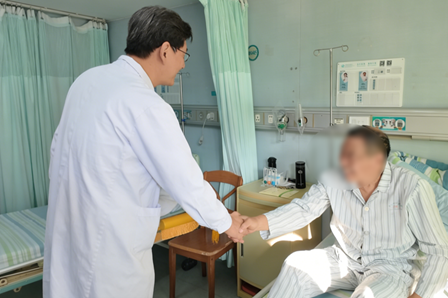
“Patients keep recommending this hospital by word of mouth—it really is different,” Uncle Ding reflected. “If it can be treated, the doctors will do everything possible. If it can’t, they’ll tell you honestly and never delay.” Recently, his sister-in-law was diagnosed with colon cancer and also chose Medical Department Six. “At Fuda, I feel at ease,” she said.
When they presented the banner this time, Uncle Ding’s wife said with reddened eyes that she had taken photos with President Niu three times—each capturing a different emotion: from anxiety to trust, from gratitude to hope. A photograph records a journey; a banner carries a family’s heartfelt thanks.
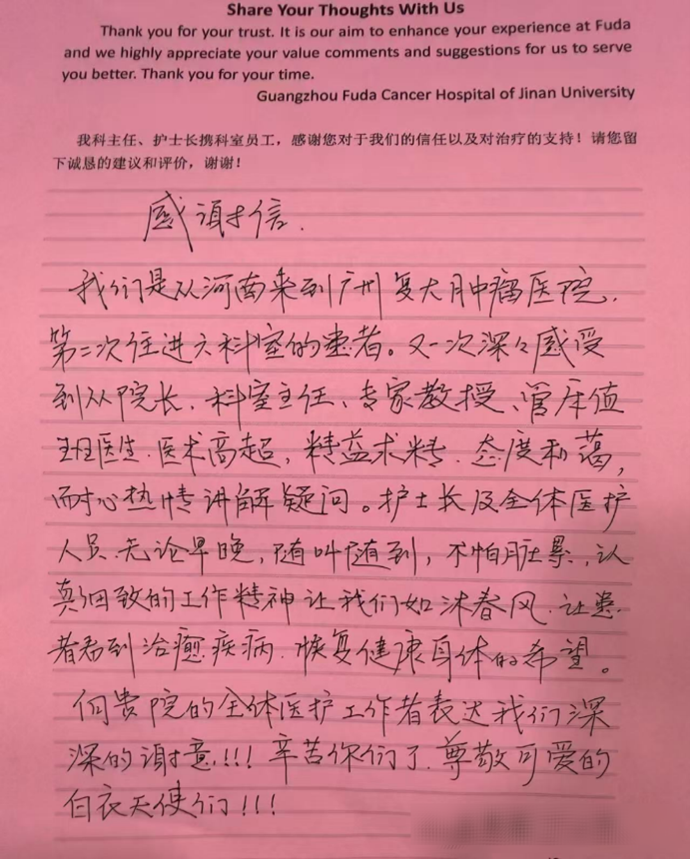
Life’s path can sometimes feel like night falling as you walk. But there are people—and places—willing to light a lamp, to walk with you through wind and rain until dawn. For Uncle Ding’s family, Fuda is that light—illuminating not only the hospital room, but hearts that had nearly given up. And that light continues to warm many others who, like them, long for a new beginning.