What began as a mild discomfort in the throat gradually worsened—until Mr. R (pseudonym) could no longer open his mouth properly, speak clearly, or even brush his teeth. Drinking water became difficult. His hearing deteriorated, headaches became frequent, and even the shape of his face slowly changed.
All of this started from what seemed like an “insignificant” throat discomfort.
Mr. R was born in an island, a small island nation in the Caribbean. Toward the end of 2024, he began to feel discomfort on the right side of his throat. At first, he paid little attention. However, the symptoms continued to worsen. By March 2025, he noticed a mass in his oropharynx, yet still delayed seeking medical care.
Two months later, lumps appeared on both sides of his neck, and hearing loss in his right ear became obvious. Only then did he realize the seriousness of the situation and underwent examinations at a hospital in the Philippines.
The diagnosis was devastating: oropharyngeal squamous cell carcinoma. By October 2025, the disease had already progressed.
At that time, Mr. R was suffering from nasal obstruction on the right side, hearing impairment, difficulty swallowing, swelling and pain in his cheek and throat, and occasional bleeding from the oropharyngeal mass. Everyday life had become a constant ordeal.
Health Insight
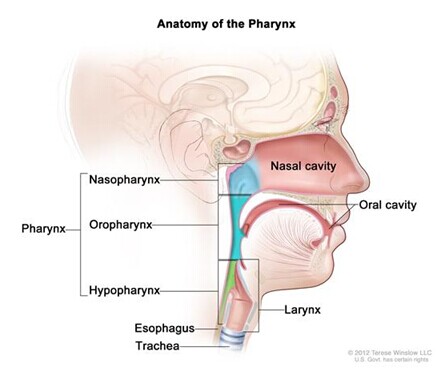
The oropharynx, hidden behind the oral cavity, acts as a vital crossroads for breathing, swallowing, and speech. When cancer develops in this area, early symptoms are often subtle and easily overlooked—such as persistent sore throat, a sensation of a foreign body when swallowing, or changes in voice.
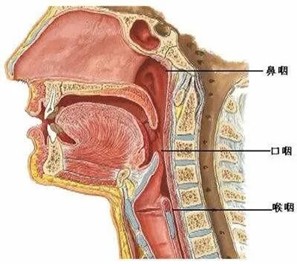
Image source: Internet
Seek medical attention promptly if you experience:
Persistent foreign-body sensation in the oropharynx, especially worsening during swallowing (unlike pharyngitis, which may improve while eating);
Continuous throat pain affecting daily life;
Oral ulcers that do not heal, or unexplained bleeding in the mouth;
Painless neck lumps (enlarged lymph nodes) unresponsive to anti-inflammatory treatment;
Difficulty opening the mouth or breathing (late-stage symptoms).
If any of these symptoms persist, timely medical evaluation is strongly recommended.
Local doctors advised radical surgery, but the potential extensive trauma led Mr. R to refuse it. In his mind, surgery was a last resort.
“There must be a more advanced and gentler option,” he believed.
Through social media, Mr. R learned about Guangzhou Fuda Cancer Hospital in China and its specialized minimally invasive treatment approaches. With a hopeful mindset, he contacted Fuda’s service center in the Philippines and completed an online consultation. When he learned that multiple treatment options were still available to him, he made a decisive choice—to travel to China.
At Fuda, comprehensive examinations revealed that the tumor had invaded the nasopharynx, soft palate, and right-sided muscles, with a high risk of bleeding. Instead of traditional open surgery, the medical team designed a personalized combination treatment plan:
Arterial infusion chemotherapy to deliver drugs directly to the tumor with high precision;
Interventional embolization to block blood vessels and reduce bleeding risk;
Combined with intravenous PD-1 inhibitor immunotherapy, reactivating the immune system to recognize and attack cancer cells.
The results exceeded Mr. R’s expectations.
Before long, his right nasal passage became clear, his hearing improved, and the neck masses visibly shrank. Swallowing was no longer difficult, and he could finally eat and sleep comfortably again. Although his voice remained slightly hoarse, his laughter was loud and genuine.
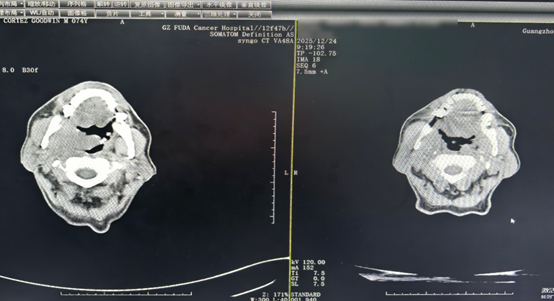
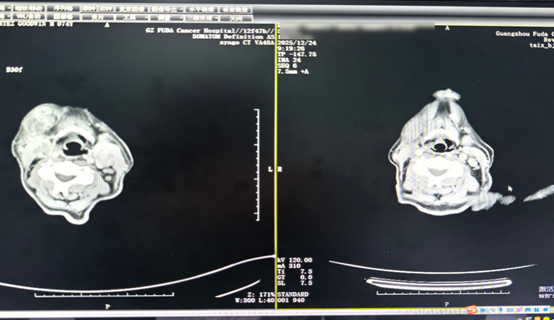
CT comparison after two treatment cycles showing reduction of oropharyngeal tumor and cervical masses
Mr. R shared that he had visited China more than a decade ago, but this was his first time coming to Guangzhou as a patient. At the beginning, anxiety kept his blood pressure elevated. Yet the hospital’s professional expertise and warm, attentive care quickly put him at ease.
This experience made him truly fall in love with China. He said that he hopes to seriously learn Chinese in the future, explore the country’s culture, and fully experience its unique charm.
Mr. R’s treatment is still ongoing. We sincerely wish him steady progress toward recovery—and a return to a life filled with sound, freedom, and color.